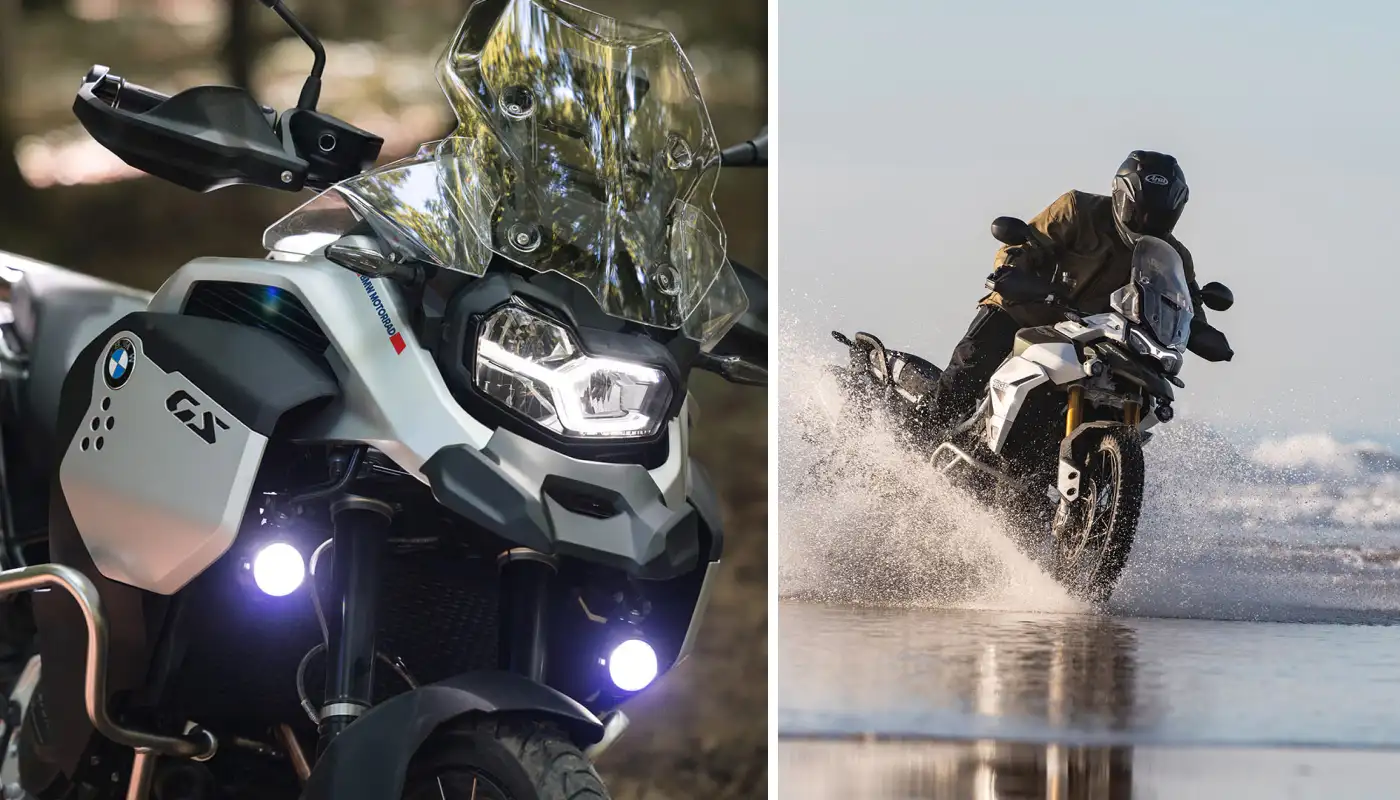
Adventure motorcycles have come a long way in balancing power, comfort, and versatility. Among the midweight adventure segment, two bikes consistently catch attention: the Triumph Tiger 900 Rally Pro and the BMW F 900 GS. Both are designed to handle highways, winding roads, and off-road trails, but each has a unique personality.
The Tiger 900 Rally Pro is built for riders who value long-distance comfort and smooth handling without sacrificing off-road capability. The BMW F 900 GS, meanwhile, delivers a sportier, more dynamic ride that emphasizes agility and performance. In this comparison, we’ll explore performance, technology, ergonomics, and value to help you decide which bike is the right adventure partner for your next ride.
BMW F 900 GS vs Tiger 900 Rally Pro
Engine Character & Power Delivery
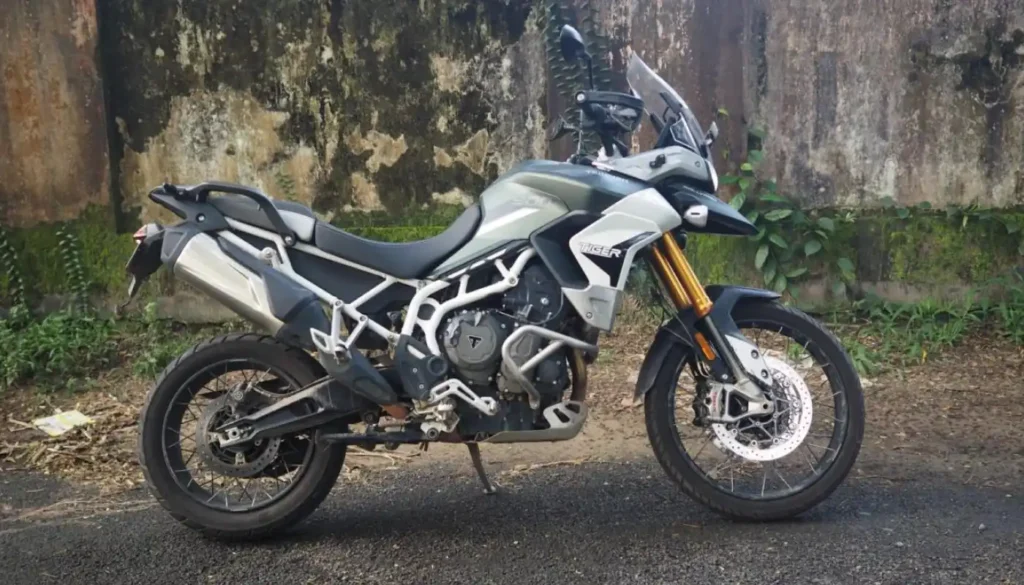
This is where the two motorcycles diverge most fundamentally — and where the choice between them becomes most personal. The Triumph’s 888cc three-cylinder T-plane triple is one of motorcycling’s defining engine personalities. With its 270-degree firing order, it produces a deep, slightly uneven thrum at low revs that builds into a howling, urgent rush past seven thousand rpm. The 2026 update brings a revised 103 bhp and 87 Nm of torque with a noticeably improved spread through the mid-range — the zone where adventure riders spend most of their time. Fuelling has been recalibrated for smoother low-speed response, which makes a real difference when threading through tight technical sections at walking pace.
The Triple’s Personality
Every motorcyclist who has ridden the Triumph triple describes it the same way: it’s fun. More fun than it needs to be. Reviewers and long-term owners consistently note that the engine rewards you for engaging with it — letting it rev, exploring the top-end rush, feeling the intake note build behind you. That character simply cannot be replicated by a parallel-twin configuration, regardless of how well-engineered it is. The T-plane crank’s firing order gives the motor a pseudo-single heartbeat at low speeds, adding to the sense of connection between rider and machine.
The BMW’s Parallel-Twin Logic
The BMW’s 895cc parallel-twin takes a different approach. Its crankshaft journals are offset by 90 degrees, creating a 270/450-degree firing interval that sounds — and feels — something like a 90-degree V-twin. Two counterbalancers minimise vibration without dulling the engine’s personality. The result is 105 hp and 93 Nm of torque that arrives in a smooth, linear wave rather than the Triumph’s more urgent, characterful surge. Back-to-back in real testing, the BMW was consistently described as smoother on motorways — which matters for a bike often used for long-distance travel — but less involving when you want to enjoy the act of riding rather than simply cover distance.
The BMW’s torque peak arrives lower and carries further through the rev range, which benefits off-road riding where smooth, controllable power delivery matters more than peak output. The Triumph’s engine, for all its excitement, requires slightly more rider management on technical trails due to its more eager throttle response at the point where control is most critical.
Off-Road Capability
The 2026 Tiger 900 Rally Pro arrives with a substantially overhauled electronics suite specifically targeting serious off-road use. The new six-axis IMU feeds updated cornering ABS and traction control, alongside a revised Off-Road Pro mode that allows more aggressive rear wheel slip before intervening — and a new dedicated Enduro mode that cuts rear ABS entirely and softens traction control to a bare minimum. This is Triumph explicitly acknowledging that committed off-road riders want control over their machine, not a nannying system that limits what the bike can do in the dirt.
Tiger’s Trail Credentials
The Rally Pro’s Showa suspension package remains class-leading: 45mm inverted forks with 240mm of travel and a monoshock with 230mm, both fully adjustable. Brembo Stylema four-piston monoblock calipers on 320mm discs provide front braking power that is genuinely impressive for a bike this capable off-road. The 21-inch front wheel and Bridgestone Battlax Adventure rubber give it the geometry and tyre choice flexibility to handle genuinely challenging terrain. In the mountains of North Georgia and Spain’s rocky trails where the bike has been tested, reviewers consistently concluded that the Rally Pro pushes into territory most rival mid-size ADVs cannot follow.
BMW’s Trail Ability
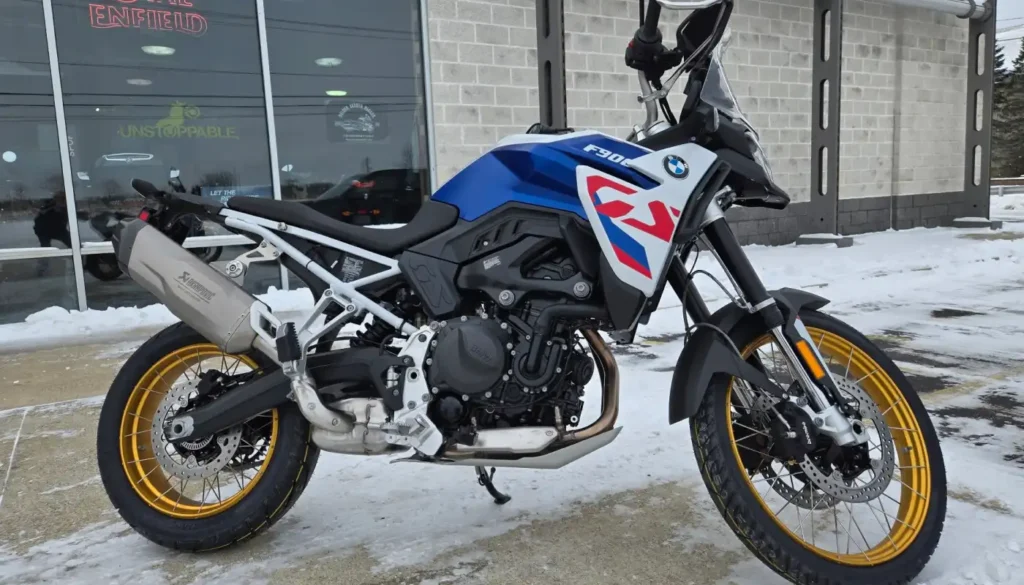
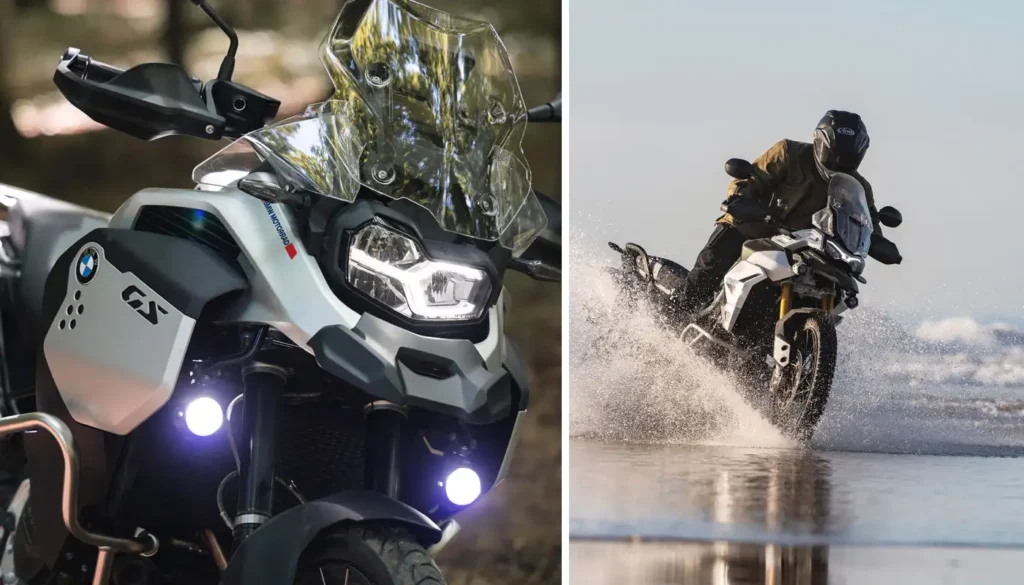
The F 900 GS is not a slouch off-road — BMW shed significant weight over the previous generation, and the resulting lighter, more nimble machine handles gravel roads, forest trails, and unpaved passes with composure and confidence. Its 43mm inverted forks deliver 220mm of front travel, and the overall package is lighter than the Tiger by a meaningful 21 kg — a difference that becomes very relevant when a bike is on its side in a ditch and needs to be picked up. However, in direct head-to-head testing on technical trails, the KTM 890 Adventure R and Tiger 900 Rally Pro’s suspension and agility edge out the GS, with reviewers noting that the BMW’s fixed windscreen and less aggressive electronics modes limit how far into the dirt you can push it confidently. Its Metzeler Karoo 4 off-road tyres help, but the Tiger’s traction control modes and Enduro setting give it a meaningful electronic advantage in serious terrain.
Road Manners & Daily Usability
This is where the BMW builds its strongest case. On tarmac, the F 900 GS is the more composed, confidence-inspiring motorcycle of the two. Its relaxed steering geometry — 28-degree rake, 4.7 inches of trail — means turn-in isn’t as brisk as the Tiger’s, but the GS’s weight reduction and wide handlebar allow it to carve corners with genuine adeptness. The lighter kerb weight (207 kg vs the Tiger’s 228 kg) makes itself felt every time you manoeuvre at slow speed, filter through traffic, or lift the bike from its sidestand after a stop. Over a full day of mixed urban and open road riding, the GS is simply less tiring to operate.
Motorway and Long-Haul Riding
The Triumph’s adjustable windscreen — which can be changed on the move with one hand — is a genuine touring advantage that the BMW’s fixed screen cannot match. At higher speeds, the Tiger’s screen offers protection with very little discomfort across its adjustment range, while the BMW’s taller accessory screen (fitted to most test bikes) induced helmet buffeting that reviewers found impossible to escape. For riders covering sustained long-distance highway miles, the Triumph’s screen management is a meaningful daily quality-of-life advantage.
On urban commuting, the BMW’s lighter weight, smoother power delivery, and slimmer midsection give it an edge in stop-and-go traffic. Both bikes have heated grips and seats on the full specification versions — essentials for year-round riding — but the BMW’s lower claimed weight makes it the easier machine to park, manoeuvre, and filter on a daily basis. For the vast majority of rides that most adventure bike owners actually take, the BMW is arguably the more pleasant tool.
Suspension on Road
An interesting nuance: the Tiger’s long-travel Showa suspension, while superb off-road, can produce slight wallowing under heavy road acceleration that the BMW’s shorter-travel setup avoids. In direct back-to-back riding, the BMW’s chassis felt tighter and more precise on flowing tarmac, while the Tiger felt more planted at higher speeds. Both are excellent road motorcycles — the question is which riding texture you prefer.
Technology & Electronics
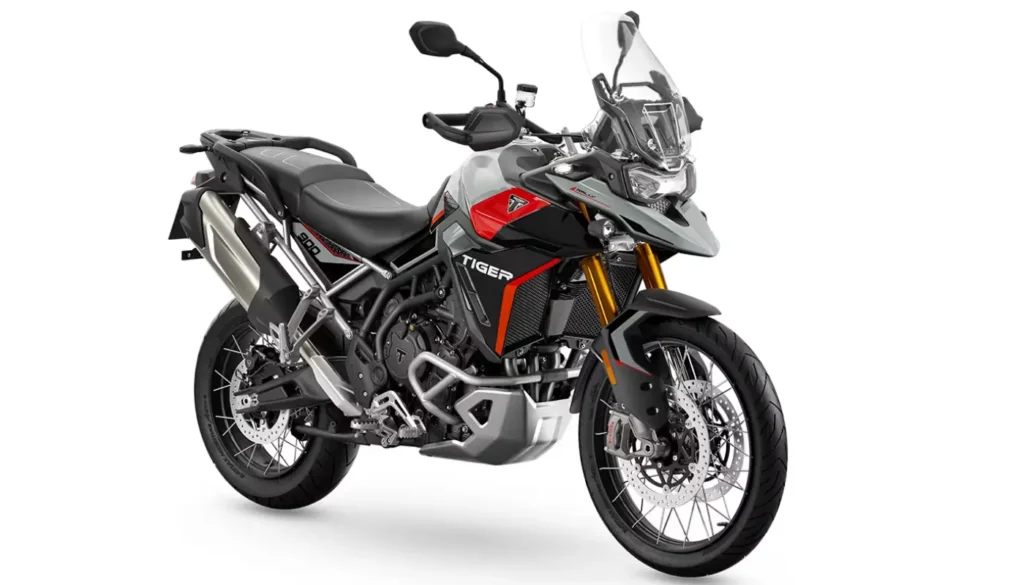
Both bikes arrive in 2026 with genuinely comprehensive electronics suites. The Tiger 900 Rally Pro’s headline tech update is the new six-axis IMU, which feeds updated cornering ABS, traction control, and the expanded riding mode suite — Road, Rain, Sport, Off-Road, Off-Road Pro, and the new Enduro mode. The 7-inch TFT display with full Bluetooth connectivity handles phone integration, navigation prompts, and ride data presentation. Bi-directional quickshifter (Shift Assist), heated seats and grips, cruise control, and Tire Pressure Monitoring (TPMS) are all standard on the Rally Pro.
BMW’s Cockpit
The BMW’s 6.5-inch TFT display is attractively designed and easy to read, with smartphone connectivity via BMW’s ConnectedRide app. The standard electronic suite on the F 900 GS includes Dynamic Traction Control, ABS Pro (cornering ABS), and multiple riding modes. The optional quickshifter (Gear Shift Assist Pro, working in both directions) is a recommended addition. The Dynamic Brake Light — which flashes under heavy braking to warn following traffic — is standard and a safety feature that many reviewers have wished would become universal. Dynamic ESA (semi-active suspension) is available as a cost option on the Adventure version.
Where Each Leads
The Triumph edges ahead on display size (7-inch vs 6.5-inch) and on the depth of its off-road-specific mode settings — particularly the Enduro mode that has no direct BMW equivalent. The BMW counters with its familiar ConnectedRide ecosystem that integrates with navigation, and its dynamic brake light safety feature. For riders who primarily care about off-road electronics, the Tiger is more sophisticated. For riders who want seamless urban connectivity and a more mature on-road tech integration, the BMW is the cleaner solution.
The 2026 Tiger 900 Rally Pro is the best version of Triumph’s middleweight adventure motorcycle since the nameplate was introduced in 2020. The engine improvements, electronics overhaul, and suspension refinements all move the needle in meaningful ways. Triumph has been listening to owner feedback — the new Enduro mode, the smoother low-speed fuelling, the improved seat and handlebars — and the result is a machine that feels purpose-built rather than compromised. Its triple-cylinder engine remains one of motorcycling’s genuinely irreplaceable personalities, and its off-road capability in Rally Pro specification is the best in its class for a road-legal adventure machine at this price point.
Where it asks for patience is in its weight and bulk at slow speeds, its premium price relative to the BMW, and the smaller-tank disadvantage of the standard model in touring configuration. These are real caveats for the right rider. But for someone who is drawn to adventure riding for the experience as much as the destination — who wants an engine that makes them grin, suspension that can handle whatever they ride into, and a technology suite that genuinely supports off-road exploration — the Tiger 900 Rally Pro is the more satisfying choice.
Strengths
- 888cc triple — irreplaceable engine character
- 240/230mm Showa suspension — class-leading travel
- New Enduro mode — full off-road control unlocked
- Brembo Stylema 4-piston front brakes
- 7-inch TFT with full Bluetooth and navigation
- Adjustable screen — moveable on the move
- 20L tank — 200+ mile real-world range
- Heated seats and grips standard on Rally Pro
- Bi-directional quickshifter standard
- 55–60 mpg fuel economy — excellent for the class
Limitations
- $3,000–£4,000 more than base F 900 GS
- 228 kg wet — heavier and more demanding at slow speed
- 860mm seat height — less accessible for shorter riders
- Slight vibrancy at motorway speeds vs. BMW
- 24.4-degree rake angle less ideal for extreme off-road
- 17-inch rear wheel limits some tyre choices
The F 900 GS is, across a wider range of rider profiles and use cases, the more pragmatic choice — and that is emphatically not a criticism. It is lighter, more agile, more affordable, and a supremely balanced all-rounder that handles everything from a wet rush-hour commute to a gravel mountain pass with composed, confidence-inspiring calm. BMW redesigned this motorcycle from the ground up for 2024, and the result is a bike that is significantly better than the machine it replaced in almost every measurable way. The parallel-twin engine may lack the Triumph’s theatre, but it rewards with smoothness, reliability, and a character that grows on you over many thousands of miles rather than overwhelming you immediately.
The BMW’s biggest practical disadvantage for touring riders is its 14.5-litre fuel tank — and buyers who intend to use it for multi-day adventures should price up the F 900 GS Adventure variant with its 23-litre tank before committing to the standard model. However, as an everyday adventure motorcycle that also handles the commute, the weekend canyon run, and the occasional trail without drama or fatigue, the F 900 GS is the one we’d recommend to most riders without hesitation.
Strengths
- $3,000+ cheaper than equiv. Tiger Rally Pro
- 207 kg — 21 kg lighter; far more manageable
- Smoother, more refined engine for daily use
- More composed and precise on tarmac
- Dynamic Brake Light — outstanding safety feature
- BMW ConnectedRide ecosystem — mature integration
- Dynamic ESA option for semi-active suspension
- 23L tank available on Adventure variant
- Stronger historical BMW resale values
Limitations
- Fixed windscreen — cannot be adjusted on the move
- Standard 14.5L tank — limits tourer range
- Less off-road capable than Tiger Rally Pro
- Parallel-twin lacks the Triumph’s engine character
- 220mm front travel — less than Tiger’s 240mm
- Brakes less powerful than Tiger’s Brembo Stylema
Score by Score: Triumph Tiger vs BMW F 900 GS Battle
Full Specification Comparison
| SPECIFICATION | TRIUMPH TIGER 900 RALLY PRO | BMW F 900 GS |
|---|---|---|
| ENGINE TYPE | 888cc Liquid-Cooled, DOHC, 4V Triple (T-Plane) | 895cc Liquid-Cooled, DOHC, 4V Parallel-Twin |
| PEAK POWER | 103 bhp @ 8,750 rpm | 105 hp @ 8,500 rpm ★ |
| PEAK TORQUE | 87 Nm @ 6,850 rpm | 93 Nm @ 6,500 rpm ★ |
| GEARBOX | 6-Speed + Bi-Directional Quickshifter (standard) | 6-Speed + Optional Quickshifter |
| FRAME | Tubular Steel Trellis | Steel Tubular + Aluminium Rear |
| FRONT SUSPENSION | 45mm Showa Inverted — 240mm travel ★ | 43mm Inverted — 220mm travel |
| REAR SUSPENSION | Showa Monoshock — 230mm travel ★ | Monoshock — 220mm travel |
| FRONT BRAKES | 2 × 320mm — Brembo Stylema 4-piston ★ | 2 × 305mm — 2-piston Brembo radial |
| ABS SYSTEM | Cornering ABS (6-axis IMU) — switchable | ABS Pro — Cornering ABS |
| WHEELS | 21-inch front / 17-inch rear — cross-spoke tubeless | 21-inch front / 17-inch rear — spoked |
| WET WEIGHT | 228 kg (503 lb) | 207 kg (456 lb) ★ 21 kg lighter |
| SEAT HEIGHT | 860mm (adjustable) | 870mm (adjustable: 830mm–890mm) |
| FUEL TANK | 20L (5.3 US gal) ★ | 14.5L — 23L on Adventure variant |
| FUEL ECONOMY | 55–60 mpg (tarmac) ★ | ~50–55 mpg (tarmac) |
| REAL-WORLD RANGE | 200+ miles ★ | ~140–160 miles (23L GSA: 200+ miles) |
| RIDING MODES | 6 — incl. Off-Road Pro + Enduro ★ | 4 standard — Road, Rain, Enduro, Dynamic |
| DISPLAY | 7-inch TFT ★ | 6.5-inch TFT colour |
| HEATED GRIPS / SEAT | Both standard on Rally Pro ★ | Optional (some packs include) |
| CRUISE CONTROL | Standard | Standard |
| TPMS | Standard | Optional |
| ADJUSTABLE SCREEN | Yes — moveable on the move ★ | Fixed (taller screen accessory available) |
| STARTING MSRP (USD) | $17,595 | $14,190 ★ ~$3,400 less |
| STARTING MSRP (GBP) | £14,495 | £10,490 ★ ~£4,000 less |
| BEST FOR | Off-road, character, long touring, involvement | Daily use, value, agility, balanced all-round |
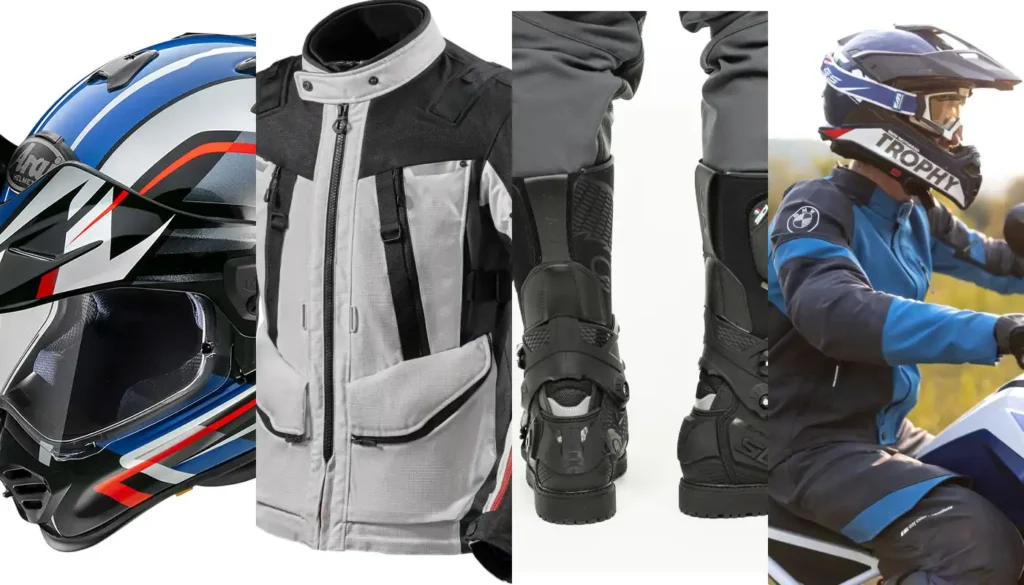
2026 Gear Guide
1. The Jacket: BMW GS Rallye GORE-TEX (2026 Collection)
This is the ultimate jacket for the GS owner.
2. The Jacket: Revit Sand 4 H2O (EU/USA Favourite)
The Sand 4 is the “Swiss Army Knife” of adventure jackets.
3. The Helmet: Arai Tour-X5
The Arai is the choice for the serious ADV rider. Its “V-shape” peak is designed to break away in a crash, and the ventilation is arguably the best for long-distance summer tours.
4. The Boots: Sidi Adventure 2 GORE-TEX
Sidi is the gold standard for European riders. These boots offer MX-level protection with a GORE-TEX membrane that is actually 100% waterproof.
Frequently Asked Questions
Final Call: The Rider Defines the Answer
For riders who prioritize agility and off-road performance, the BMW F 900 GS shines with its responsive engine and sporty handling. It’s ideal for those who love pushing limits on trails or twisty roads.
If you want a well-rounded adventure motorcycle that balances comfort, technology, and versatility, the Triumph Tiger 900 Rally Pro is the standout. It’s just as capable on highways as it is on gravel tracks, making it an excellent choice for riders seeking long-distance confidence and smooth performance.
Ultimately, the “winner” comes down to your personal riding style—choose the bike that excites you every time you hit the throttle.