
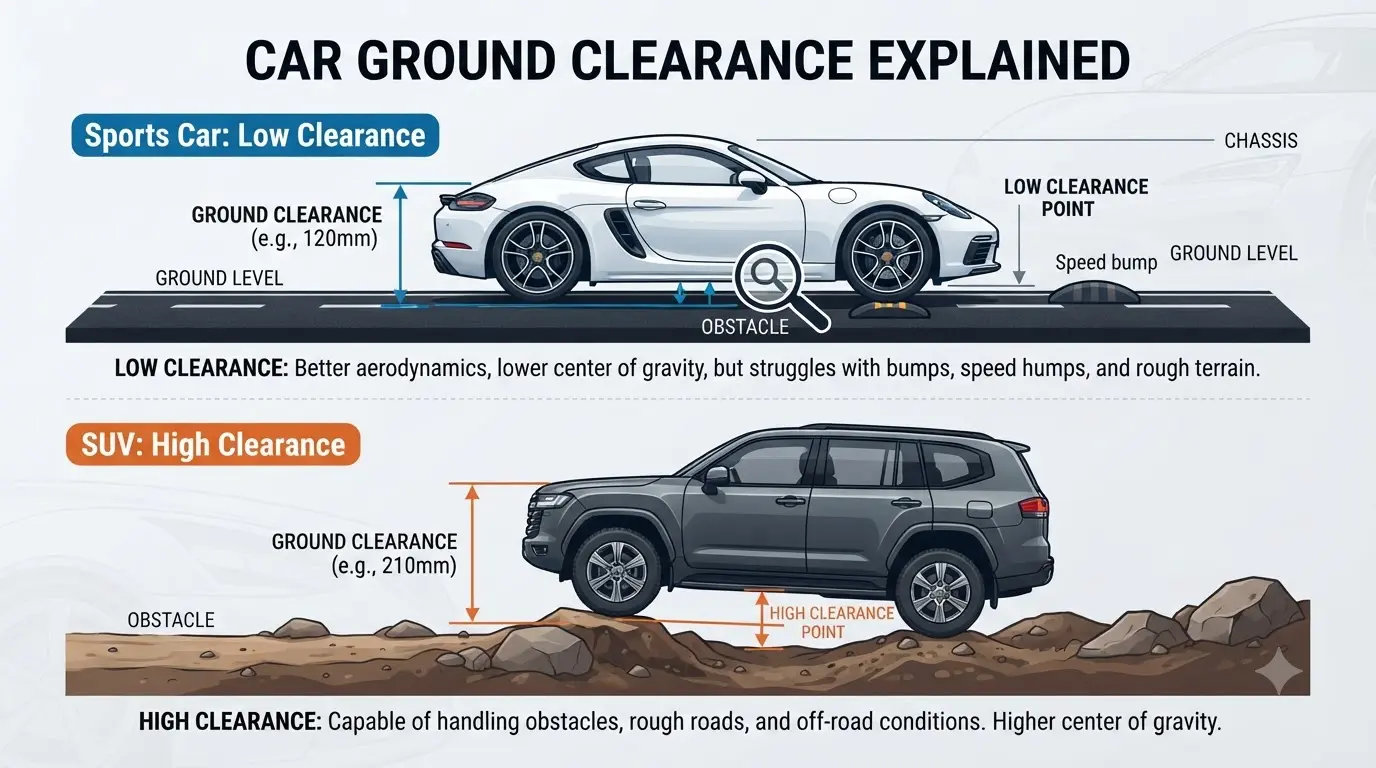
When you look at a car brochure, you will see many numbers: engine size, fuel use, boot space, and safety ratings. One figure that often gets less attention, but affects your daily life a lot, is ground clearance. It sounds technical, but in simple words, it is just the space between the lowest part of your car and the road. That small gap decides how easily your car goes over speed bumps, broken roads, steep ramps, and rough patches. It also changes how the car feels when you turn, how stable it feels at speed, and even how much fuel it uses. In short, ground clearance is one of those quiet details that shapes your whole driving experience.
What Is Ground Clearance?
Ground clearance, also called ride height, is the vertical distance between the ground and the lowest fixed point under the car. This is usually something like the oil pan, exhaust, differential, or a crossmember, not the wheels or tires.
Most manufacturers measure this with the car unloaded, which means no passengers, no luggage, and sometimes even with a half full fuel tank. That is why your real world clearance can be a bit lower when the car is fully loaded with people and bags.
A simple way to picture it: park the car on flat ground, then imagine a straight line from the road up to the lowest hard part under the car. That distance is your ground clearance.
How is ground clearance measured?
The official way to measure ground clearance is quite simple, but it needs care:
- Park on completely flat, level ground. A slope of even a few degrees will change the reading noticeably.
- Check that your tyres are inflated to the correct pressure listed on the door jamb sticker. Under-inflated tyres will lower the car and give you a falsely low reading.
- Get underneath the car (carefully) and identify the lowest hard point. Common candidates are the exhaust system mid-section, the oil sump, the spare wheel carrier, or a tow hitch attachment point. Use a torch if you need to see clearly.
- Hold a tape measure vertically from the ground up to that lowest hard point. That vertical measurement is your ground clearance.
- Note the conditions how much fuel is in the car, whether anyone is seated, and whether any luggage is loaded. Record tire pressure, fuel level, passengers, cargo, and accessories because each can change the real number.
Some people also check clearance with a straightedge and a small ramp tool to see how the car behaves over obstacles. This helps when thinking about steep driveways, rough tracks, or low ramps in parking garages.
It is also worth noting that ground clearance changes with load. A car that has 180 mm of clearance when empty might drop to 160–165 mm when fully loaded. That is why it is smart to think about your usual use, not just the brochure number.
Why Does Ground Clearance Matter?
Ground clearance is more than just a design specification it affects almost every aspect of a vehicle’s performance, from handling to comfort.
Here are the 3 main ways ground clearance affects your daily driving life:
1. Speed bumps and broken roads
If you often drive on roads with deep potholes, high speed bumps, or broken surfaces, higher ground clearance helps. It reduces the chance of scraping the underbody, damaging the exhaust, or hitting the oil pan.
In cities with poorly maintained roads or frequent construction, a car with very low clearance can become stressful to drive. You end up slowing down for every bump and worrying about hidden stones or deep ruts.
2. Steep ramps and driveways
Multi-level parking lots, steep driveways, and low ramps can be tricky for cars with low ground clearance. The front bumper or undertray can scrape when going up or down, especially if you approach at an angle.
A bit more clearance gives you more confidence in these situations. You do not have to crawl up the ramp or take a strange angle just to avoid a loud scrape.
3. Light off-road and rural roads
If you sometimes drive on gravel tracks, farm roads, or light off-road paths, ground clearance becomes even more important. It helps the car clear rocks, ruts, and uneven ground without getting stuck or damaged.
This does not mean you need a full off-roader. Even a small increase in clearance can make a big difference on rough rural roads or during bad weather when the road surface is uneven.
How ground clearance affects handling and safety
Ground clearance is not just about avoiding scrapes. It also changes how the car behaves on the road.
Center of gravity and body roll
A car with higher ground clearance has a higher center of gravity. This means the car’s weight sits higher above the road. In simple terms, the car can feel a bit more “top heavy.”
When you take a fast corner or make a sudden turn, a higher car will lean more. This is called body roll. More body roll can make the car feel less sharp and can reduce your confidence in quick maneuvers.
A car with lower ground clearance has a lower center of gravity. It usually corners with less body roll, feels more planted, and gives a sportier, more connected drive. This is one reason why many sports cars and sedans sit low.
Stability and rollover risk
Because of the higher center of gravity, tall SUVs and crossovers with very high clearance can be more prone to rollover in extreme situations, especially if driven too fast in sharp turns. Modern electronic stability systems help a lot, but the basic physics still apply.
Lower cars are generally more stable in fast cornering and emergency maneuvers. That is why many performance cars are designed to sit close to the ground.
Braking and road holding
Ground clearance also affects how the car holds the road under braking and in crosswinds. A lower car often feels more “glued” to the road, while a very high car can feel a bit more floaty at highway speeds, especially in strong winds.
This does not mean high clearance cars are unsafe. It just means they behave differently, and you should adjust your driving style to match. Smooth inputs and sensible speeds go a long way.
Ground clearance and fuel economy
There is another hidden effect: fuel use. A car that sits higher usually has more air resistance, or drag, because more air flows under the car. This can slightly increase fuel consumption at highway speeds.
A lower car often cuts through the air more cleanly. With less drag, the engine does not have to work as hard to maintain speed, which can improve fuel economy. This is one reason why many electric cars are designed with low ride heights and smooth underbodies.
The difference may not be huge, but over thousands of miles, it adds up. If you do mostly highway driving and care about fuel or energy use, lower ground clearance can be a small advantage.
High vs low ground clearance: pros and cons
| Factor | Higher ground clearance | Lower ground clearance |
|---|---|---|
| Obstacle clearance | Better over bumps, ruts, and rough roads | More risk of scraping on bad surfaces |
| Center of gravity | Higher, more body roll | Lower, sharper handling |
| On-road stability | Good, but can feel taller at speed | More planted and stable |
| Fuel or energy use | Slightly higher drag, more use | Slightly lower drag, better use |
| Comfort on rough roads | Usually better, less underbody impact | Can feel harsher, more risk of damage |
| City and parking ramps | Easier over steep ramps | Need more care on steep entries |
| Light off-road use | More capable on rough tracks | Not suited for rough terrain |
Typical ground clearance by vehicle type
While numbers vary by model, you can expect rough ranges like these:
- Small city cars and hatchbacks: around 130–160 mm.
- Sedans and coupes: around 130–150 mm.
- Compact SUVs and crossovers: around 170–200 mm.
- Mid-size and large SUVs: around 190–220 mm.
- Off-road focused SUVs and 4x4s: often 210–250 mm or more.
These are general figures, not rules. Some crossovers sit quite low for better handling, while some sedans are raised for rough road markets. Always check the specific model you are interested in.
How to choose the right ground clearance for you
Think about your daily life and the roads you use most.
- If you mostly drive on good city roads and highways, and you like a sporty feel, a car with lower to medium clearance can be great.
- If you face bad roads, frequent speed bumps, or rural tracks, a car with medium to high clearance will save you from constant worry.
- If you often carry full loads or tow, remember that clearance drops with weight, so start with a bit more margin.
- If you love weekend trips to rough areas, higher clearance gives you more freedom and less risk of damage.
It is also worth test driving on roads you know well. Take your usual route with speed bumps and broken patches. See how the car feels and whether you find yourself slowing down too much or worrying about scraping.
Frequently Asked Questions
Final Thoughts
Ground clearance is one of those details that seems small on paper but shapes your daily driving a lot. It affects how you handle speed bumps, how confident you feel on rough roads, how the car corners, and even how much fuel or energy it uses. When you look at your next car, do not just focus on looks and engine size. Check the ground clearance, think about your usual routes, and imagine how the car will behave when fully loaded. That simple step can save you from many small headaches and make your driving life much easier.