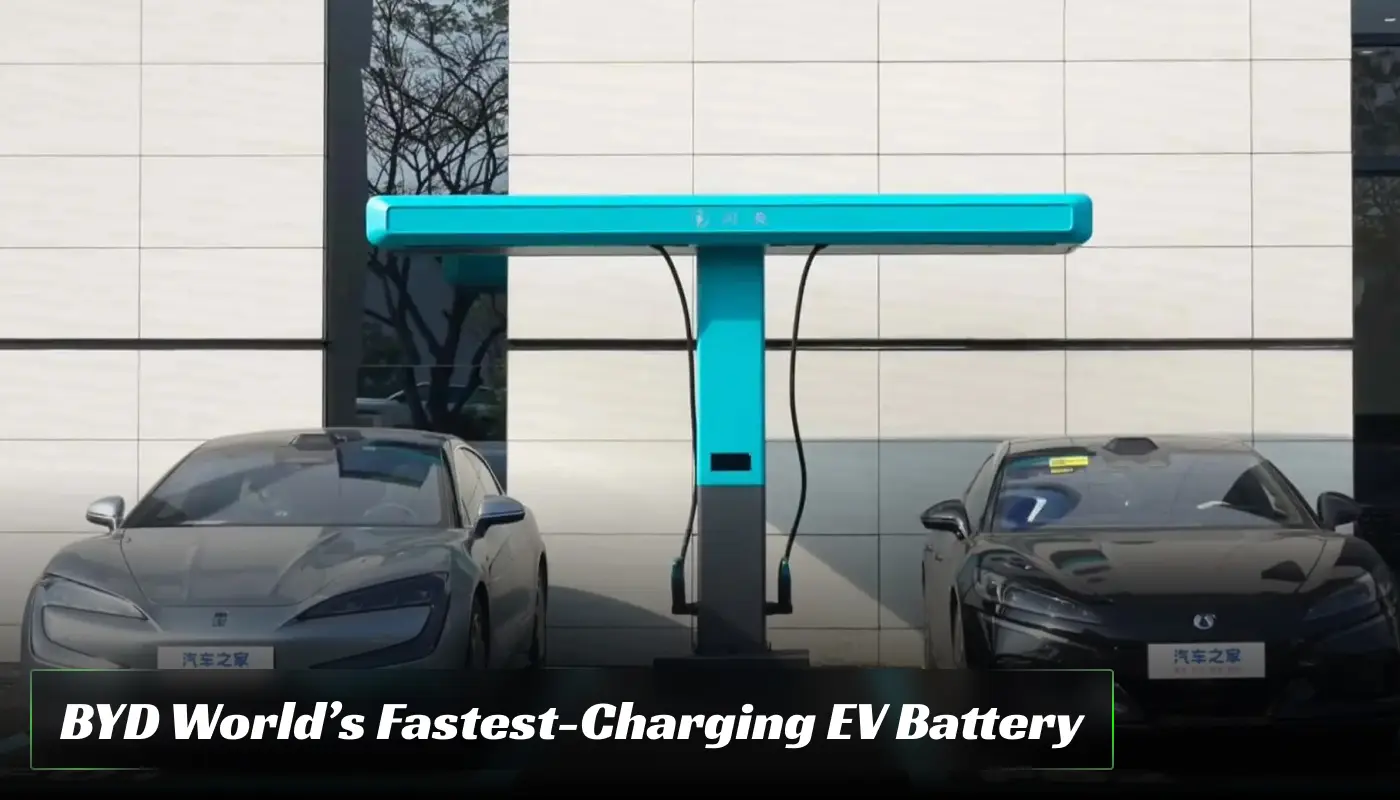
For years, one question has held many buyers back from electric cars: “What if I need to charge on a long trip and do not want to wait?” BYD now has a bold answer. The company has unveiled what it calls the world’s fastest charging EV battery, capable of adding around 300 km of range in just 5 minutes and reaching 10% to 97% charge in about 9 minutes under the right conditions.
What exactly did BYD announce?
BYD’s new system is built around two key parts:
- Second generation Blade Battery (LFP chemistry).
- Flash Charging technology and chargers.
Together, they allow compatible vehicles to charge from 10% to 70% in about 5 minutes, and from 10% to 97% in around 9 minutes at normal temperatures. In real-world terms, that can mean adding roughly 300 to 400 km of range in a very short stop, depending on the car and test cycle used.
The headline charging power is up to 1,500 kW (1.5 MW) per connector in BYD’s Flash Charging network. That is far above the 250–350 kW seen at many current fast-charging stations.
How does the new Blade Battery work?
The second-generation Blade Battery uses BYD’s familiar Lithium Iron Phosphate (LFP) chemistry, but with major internal upgrades. BYD says it spent six years developing a new FlashPass Ion Transport System, which redesigns key parts of the cell:
- Cathode structure to move ions more efficiently.
- Electrolyte formula to reduce resistance.
- Anode design to handle very high charging currents.
These changes help lithium ions travel faster inside the battery, lower internal resistance, and allow extreme charging rates without overheating or degrading quickly. BYD claims the new battery has about 5% higher energy density and 2.5% less capacity loss over time compared to the first-generation Blade.
Which cars can use this technology?
The Flash Charging system is designed for BYD’s newer EVs and related brands. Models expected to support it include vehicles under:
- BYD (for example, the third-generation Tang EV).
- Denza (such as the Z9 GT).
- Yangwang (like the U7).
- Fangchengbao.
The third-generation BYD Tang EV, for instance, offers battery options of around 88.7 kWh and 105.8 kWh, with claimed CLTC ranges up to 850 km. On compatible Flash Chargers, it can go from 10% to 70% in about five minutes at normal temperatures.
It is important to note that not every BYD EV can charge this fast yet. The technology depends on both the battery design and the car’s electrical system. Older models and many non-BYD EVs will still use slower charging speeds.
How fast is this compared to other EVs?
To put the numbers in context:
- Many current EVs: 10–80% in 20–30 minutes at 250–350 kW chargers.
- BYD Flash Charging: 10–70% in ~5 minutes, 10–97% in 9 minutes at up to 1,500 kW.
- In distance terms, BYD talks about roughly 2 km of range per second of charging, about 300–400 km in 5 minutes under CLTC testing.
That is close to the time it takes to fill a petrol car at a pump, at least for the main part of the charge. For long trips, this could mean a quick stop for coffee and a restroom break instead of a long wait.
Does ultra-fast charging harm the battery?
This is the question many buyers ask. If you charge this fast all the time, will the battery die young? BYD has tried to answer that with a public test. The company took a Yangwang U7 and:
- Drove it about 30,000 km in 9 days.
- Used 350 ultra-fast charging stops in that period.
- Then checked the battery health.
Result: the battery retained 98.7% of its original capacity, with only 1.3% loss after this extreme use. While this is a manufacturer test and not an independent long-term study, it suggests that the new battery and charging system are designed to handle frequent fast charging without major degradation.
Where will these chargers be available?
BYD is not just showing a lab prototype. It is building a network. The company reports that it has already installed around 10,000 Flash Charging stations in under six months, with plans for many more. Most of these are in China for now, but BYD has started talking about bringing the system to other markets, including North America.
For example, reports indicate that Flash Charging stations are coming to Canada, which would be the first step toward wider availability in North America. If this expands, it could put pressure on other networks to speed up their own chargers.
Frequently Asked Questions
Final Thoughts
BYD’s new Flash Charging technology could transform EV charging, delivering up to 300 km of range in just 5 minutes and charging from 10% to 97% in only 9 minutes. With promising early battery durability tests, BYD’s breakthrough could make long EV charging stops a thing of the past. BYD’s ultra-fast EV charging marks a major step toward faster, more convenient electric mobility.